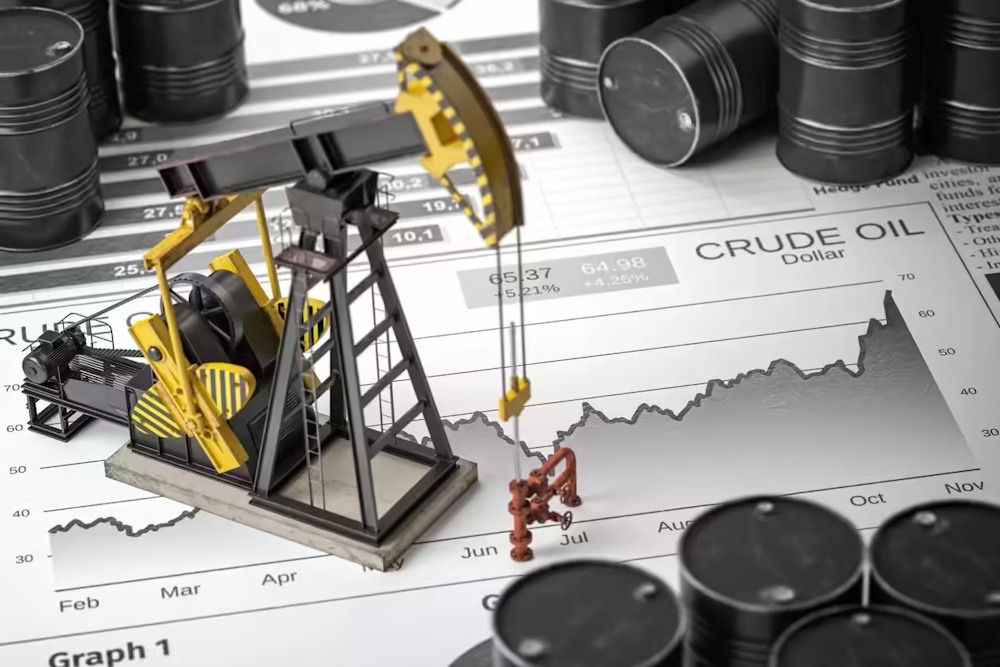
Oil prices experienced an uptick on Wednesday following US President Donald Trump’s dismissal of claims regarding a potential easing of sanctions on Iran, coinciding with Qatar’s advocacy for peace negotiations. Prices had declined in the prior session as crude supply from the Middle East exhibited indications of recovery. Trump, however, denied an Axios report citing US officials who said he was willing to provide Iran with sanctions relief and release frozen Iranian funds in exchange for “concrete” steps from Tehran on its nuclear programme. “This is untrue. I offered them nothing,” Trump wrote on his Truth Social account. Brent crude futures increased by $1.14, representing a rise of 1.11%, reaching $103.73. Meanwhile, US West Texas Intermediate crude saw a gain of 15 cents, or 0.30%, bringing the price to $89.50 per barrel. Brent is poised to achieve a monthly increase of approximately 14%, marking its most significant rise since July. WTI is poised for a 4% monthly increase following its earlier ascent past $106 a barrel, marking the first occurrence since May.
US President Donald Trump is contemplating the option of permitting sales of red-dyed diesel instead of enforcing an export ban, a strategy designed to offer some relief to consumers in the lead-up to the November mid-term elections. Qatar said on Tuesday it hoped shuttle diplomacy between Iran and the US could produce a breakthrough. “We are exchanging messages between the parties, and we’re working towards establishing a common ground in order to get into a deal that would save all of us from the repercussions of the conflict,” source reported. Saudi Arabia resumed oil tanker loadings from its Red Sea port of Yanbu on Tuesday following the restart of operations on the East-West Pipeline. Crude oil exports from Middle Eastern producers rebounded to 16.328 million barrels per day in September, marking the highest level since the onset of the US-Israeli conflict with Iran in late February.
The prevailing uncertainty has further complicated the ability of major banks to assess the trajectory of oil prices. JPMorgan indicated that it has lost visibility on the market and, for the first time since the onset of the Iran war in February, no longer possesses a clear baseline scenario. The bank indicated that the rise in tensions was contributing to apprehensions regarding an already deteriorating supply shock. “We simply don’t know how to model the endgame,” JPMorgan analysts said, pointing to the uncertainty over how the conflict could unfold. At the start of the conflict, the bank had assumed there were economic thresholds the US administration would not cross. Six months into the war, JPMorgan said many of those thresholds had been crossed, while there was still no clear exit strategy.
The prospect of further supply disruptions has also heightened the potential for oil prices to ascend. Daan Struyven stated that recent attacks indicated that disruptions to shipping could proliferate and intensify. Goldman Sachs has delineated a scenario wherein oil prices might ascend to $120 a barrel should assaults on vessels in the Middle East escalate. If exports return to normal, the bank anticipates that oil prices will trend back toward $80 a barrel. Struyven stated that shipping risks had emerged as a significant factor influencing oil prices. Goldman Sachs anticipates “meaningful upside to crude oil prices” and also projects an increase in natural gas and refined product prices. Struyven indicated that supply shocks in petrol and fuels are more significant than those observed in the crude market.